The conference
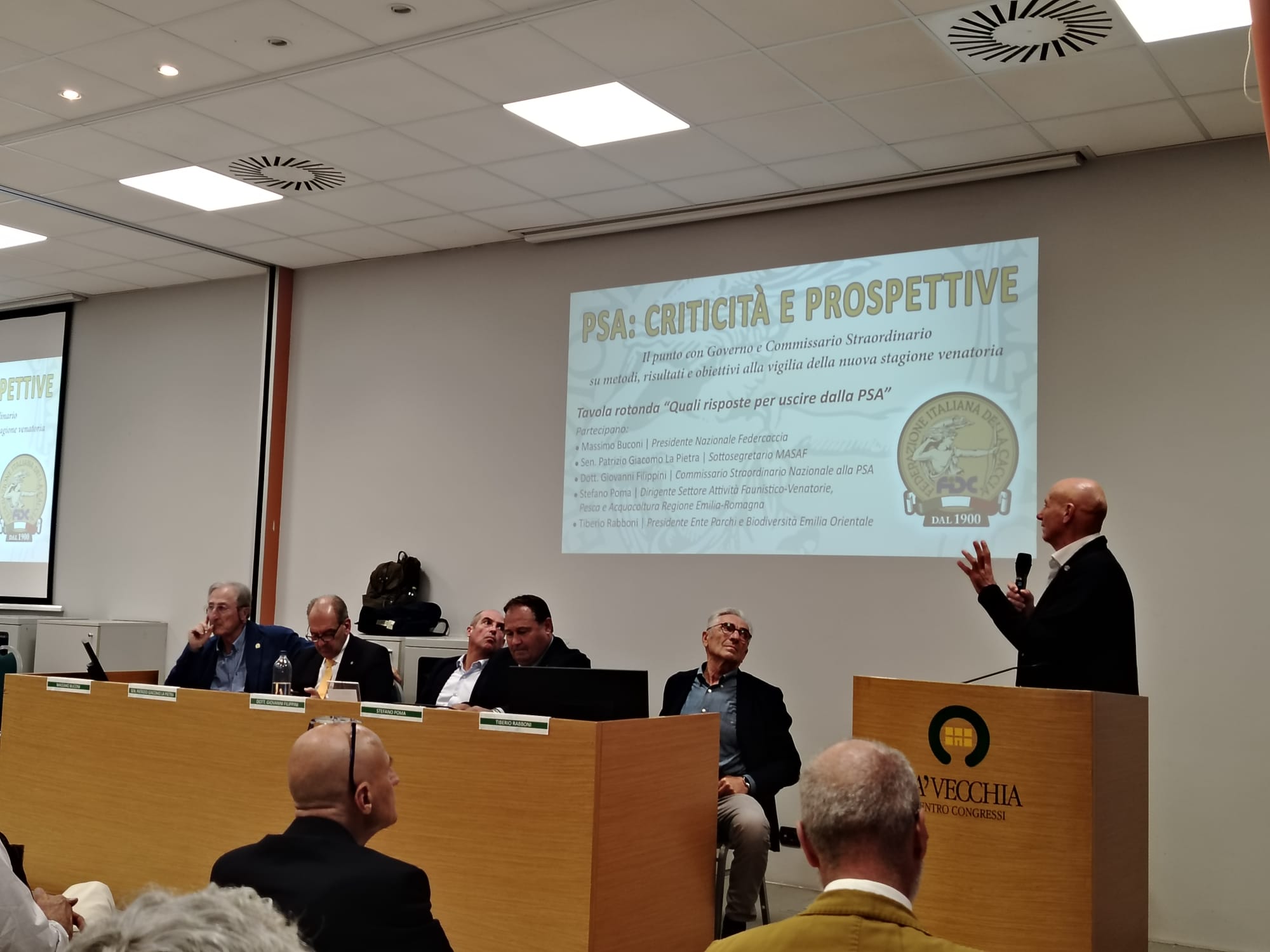
Coordinated action against African Swine Fever between institutions, the agricultural world, and the hunting community was launched at the conference "PSA Critical Issues and Prospects," promoted by Federcaccia Bologna, Emilia-Romagna, and the National Association of Hunting Federations (Ferdercaccia Nazionale), held recently in Sasso Marconi. Opening the conference, Paolo Pini, National Councilor for Federcaccia, explained the rationale: accurate information on ASF and the Commissioner's ordinances, clarifying operating procedures, and building synergies on the eve of the hunting season. "We wanted this opportunity for discussion," Pini emphasized, "to provide clear answers to hunters and the local community, avoiding any scaremongering, and to bring together those who work every day to contain ASF."
First round table discussion
Moderated by Federcaccia's Press Office Director, Marco Ramanzini, the first roundtable discussion has begun, aimed at highlighting the concrete challenges that the PSA and the commissioner's ordinances are creating for agricultural activities and wildlife and hunting management in the area. Marco Elmi, Vice President of Federcaccia Bologna, outlined the situation: "Our province covers 45.000 hectares of restricted zones plus 8.700 hectares of parkland. To do a good job in such a vast and challenging area, we need the right tools. We have asked to use six dogs for each tracking operation. This is the minimum number needed to be effective and achieve a truly satisfactory result; otherwise, we risk wasting all our efforts and achieving disastrous results." It is right that after a negative test, which is 98% reliable, the meat can be released from the area. He criticizes the 15-day self-certification requirement, which is only valid for hunting. “In Bologna,” Elmi concludes, “1.322 hunters have been trained in biosecurity in 7 municipalities and 8 collection centers.”
The importance of wild boar hunters
Enrico Dini, President of ATC BO2, and Lorenzo Benedetti, President of ATC BO3, emphasized the importance of wild boar hunting teams: "They are volunteers, and they guarantee the economic sustainability of the ATCs and 85% of the culls. We are moving from hunting to controlled culling; a clear system is needed." Compensation is a key issue: the ATCs emphasized their commitment to reimbursement for wildlife damage, the costs incurred by the teams for upgrades, fuel, and collection centers, and the need to expedite compensation for operators, with simplified procedures and clear deadlines, and without burdening the local communities with the costs of the emergency.
Italians Farmers and breeders
Alessandro Scala, representing Coldiretti Bologna, and Riccardo Evangelisti, representing CIA Emilia-Romagna, spoke out from the agricultural and livestock sectors, emphasizing that the pork supply chain is being brought to its knees by health restrictions and trade bottlenecks. The agricultural associations are calling for targeted public investments to ensure sustainability, farm safety, and the viability of the production and commercial supply chain, along with more streamlined and agile procedures for those who work in the field every day.
The institutions
After the situation was outlined and requests for more effective interventions were made, it was the institutions' turn to make their voices heard, convening the second working group. Giovanni Filippini, National Extraordinary Commissioner for ASF, emphasized that "The enemy is the virus. We need determination and shared strategies. The key player in the local area is the hunter: to anticipate the disease, we need someone who knows the woods. We are ready to evaluate targeted exemptions if they are functional to the objective. A goal I need you to achieve." For his part, Senator Patrizio La Pietra, Undersecretary of MASAF, emphasized that "The MASAF-Health-Commissioner model works, as demonstrated by the unanimous EU eradications." A path, he concluded, "which we must continue with unity of purpose, without placing the burden on a single category, valorizing the hunter as a fundamental ally in protecting the livestock sector and the environmental balance."
The allocated funds
Stefano Poma, from the Wildlife and Hunting, Fisheries, and Aquaculture Sector of the Emilia-Romagna Region, outlined the Region's commitment: over €14 million has been allocated (€3 million for depopulation, €11 million for biosecurity) plus a €1 million grant to the Provinces. The goal is to achieve up to 150% of collections in certain areas, and carcass searches will be conducted by ENCI and GOT dog units in Piacenza, Parma, Reggio Emilia, Modena, and Bologna, in accordance with Ordinance 7/2026. Finally, Tiberio Rabboni, President of the Management Body for Parks and Biodiversity of Eastern Emilia, emphasized the Region's commitment to interventions in protected areas, highlighting the "cooperation and full availability of the wild boar teams involved in the Park areas, with whom we have established a concrete and effective collaboration.
Federcaccia's position
Among the scheduled speeches, a special mention should be made of the Deputy Commander of the Provincial Police, Tommaso Fulgaro, who emphasized that it is the Corps' specific responsibility to implement regional control plans and coordinate personnel operating in the area: "And to achieve the expected results, it requires clear rules, uniform procedures, and a clear chain of command for all stakeholders." Massimo Buconi, National President of Federcaccia, was responsible for drawing conclusions at the end of an intense and constructive afternoon. He thanked all participants and speakers for its success, particularly Undersecretary La Pietra and Commissioner Filippini, whom he acknowledged for their full willingness to engage with the hunting community and beyond. In closing, Buconi emphasized the hunter's role as an indispensable point of reference for land management and the fight against ASF: "We must emerge from this emergency as quickly as possible with a structural model for wild boar containment, based on effective coordination at all levels between the Government, Commissioner, Regions, and local authorities." "Federcaccia is here," Buconi concludes, "but we need streamlined procedures, clear rules, and unity of purpose to quickly free the territories from restrictions."
You May Also Like ..