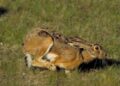
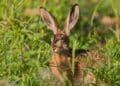
The Alpine hare belongs to the order Lagomorpha, family Leporidae, small to medium-sized mammals characterized by their abundant, continuously growing incisors. The Alpine hare is a medium-sized species, with a body length of 50 to 61 cm; its tail typically measures 5–8 cm, and its ears 10–12 cm. The sexes are similar. In summer, it can be distinguished from the common hare by its tawny or reddish-brown fur, which is visibly mottled, and by its shorter ears; it is more similar in appearance to the wild rabbit, from which it can be distinguished by its less tawny, more grayish fur. Also commonly called the mountain hare or mountain hare , the Alpine hare has an unmistakable, camouflage-like white coat during the winter. The tracks are very similar to those of the brown hare , but feature a wider contact surface, similar to a snowshoe, which facilitates and speeds up progress on the snow cover; the toes are quite long and covered in fur, and are kept maximally outstretched on the powdery snow substrate. In dangerous situations, the Alpine hare , like the brown hare , is able to emit a sound similar to a bleat.
The Alpine hare: Habitat and distribution range.
The Alpine hare lives at high altitudes, generally above 1500 m above sea level, frequenting habitats such as heathland, shrublands, and alpine pastures, along the edges of forests. In the northern reaches of its range, where the common hare is absent , it also inhabits the plains. In summer, the Alpine hare is primarily active at night, but in winter, it alternates between foraging for (scarce) food and resting throughout the day. The Alpine hare spends the warmest daytime hours not in burrows dug into the ground, but in adapted nests under rocks or plants. Its diet varies considerably from season to season: in summer, it feeds on various herbaceous and shrubby species and their fruits, while in the colder months, it feeds primarily on small branches, tender bark of mountain trees and shrubs, mosses, lichens, and conifer seeds. The Alpine hare never drinks: it obtains fluids through food and, in winter, when it can only follow a diet low in water-containing substances, it directly ingests small quantities of snow. It is a solitary species, characterized by limited social relationships, even those of pairs. The reproductive period of the Alpine hare , during which two or three equal births can occur, runs from March to June; after a gestation period of about 50 days, pups weighing around 100 g are born, already independent, and are weaned after just 15 days. Its range extends across most of the northern territories of the Eurasian continent, from the British Isles to Japan. The species is also present in the Alpine Arc, but is absent from the Pyrenees. In Italy, it is distributed relatively continuously throughout the Alps, within the Alpine and sub-Alpine horizon, with a partial overlap in its range with the common hare.
The Alpine hare: Population size and trend.
The densities in the Alps are however rather low compared to the optimal ones of 80 individuals / 100 hectares found, for example, in Scotland. In fact, in the Alps, the species always has rather low densities (for example 3-4 individuals / 1000 ha in the province of Sondrio; Prigioni et al., 2001).
The Alpine Hare: Conservation and Management.
The Alpine Hare since the possibility of carrying out immissions with individuals from Scotland and Scandinavia has been considered several times, a first threat to the conservation of the species could be the genetic pollution deriving from this type of operations. Careful management of hunting and mountain tourism activities throughout the year is desirable; the latter constitutes a strong cause of stress during the wintering period, both in terms of direct disturbance and due to the parallel increase of direct predators (Fox and Corvids), which easily find food in landfills or high-altitude residences at any time of the year. It is therefore advisable to promote environmental education actions to avoid the abandonment of food residues and the administration of food to fauna (Prigioni et al., 2001). Since the alpine hare belongs to a very selective species from an environmental point of view and characterized by a rather low birth rate, in areas where it is in decline it seems necessary to adopt a ban on hunting alpine hare, while where the populations appear stable, a regulation of the withdrawal commensurate with the annual productivity is indispensable (Spagnesi & De Marinis, 2002).
The woodcock, with its camouflage plumage, blends perfectly into the autumn undergrowth. This extraordinary adaptation guarantees protection from predators during migration. The woodcock (Scolopax rusticola), often called the "queen of the woods", is one of the birds...
__fg_link_0__ due to its smaller size, the body of a more squat shape, the hind limbs longer than the forelegs. The color of the coat ranges from sandy to dark gray-brown; the back is reddish, the abdomen and the lower part of the ...
FOX (Vulpes vulpes) Phenology S N R FOX: Description The Fox belongs to the order Carnivora, family Canidae. The Fox is a medium-sized mammal (moreover very variable through its enormous distribution range). On average, an adult individual has a height at the withers that ...
TAUPE (Streptotelia turtur) Phenology S N R Tortora: Description The Tortora belongs to the order Columbiformes, family Columbidae, the same that includes Wood pigeon and Pigeon. The Tortora differs from them for the small size (about 27 cm), for the slimmer and more elegant figure, and for ...
SASSELLO THRUSH (Turdus iliacus) Phenology S N R Sassello Thrush: Description. The Sassello Thrush belongs to the order Passeriformes, to the Turdidae family; the Redwing is the smallest of the common thrushes, measuring about 20 cm. It is very similar to the Song Thrush in the plumage of the upper parts, brown-gray, ...
BOTTACCIO THRUSH (Turdus philomelos) Phenology S N R BOTTACCIO THRUSH: Description The song Thrush belongs to the order Passeriformes, family Turdidae. It is a bird of medium to small size (about 22 cm), with a brown back and yellowish flanks and throat, paler on the belly. The lower parts of the ...
STARNA (Perdix perdix) Phenology S N R LA STARNA: Description The Starna belongs to the order Galliformes, family Phasianidae. The Gray Partridge is a medium sized Galliforme, measuring between 29 and 31 cm, slightly smaller than the Red Partridge. The Gray Partridge has a gray color ...
QUAIL (Coturnix coturnix) Phenology Y N R THE QUAIL: Description The Quail belongs to the order Galliformes, family Phasianidae. The Quail, the smallest European galliform, has a length of 16-18 cm and has a squat shape, both on the ground and in flight, so much so that it resembles a ...
RED PARTRIDGE (Alectoris rufa) Phenology S N R RED PARTRIDGE: Description The Red Partridge belongs to the order Galliformes, family Phasianidae. The Red Partridge is a galliform with a stocky and compact appearance, measuring about 33-35 cm, and is very similar to the Gray Partridge especially in the juvenile plumage. Adults of ...
Ptarmigan (Lagopus mutus) Phenology S N R Ptarmigan: DescriptionThe Rock Ptarmigan belongs to the order Galliformes, family Tetraonidae. Of medium size (35 cm), the Rock Ptarmigan is a species characterized by a showy sexual and seasonal dimorphism which manifests itself in different colors of the plumage.
Caccia Passione Srl
via Camillo Golgi nr. 1, post code 20090 Opera (MI) ITALY
CF and VAT number 08016350962
Newspaper registered at the Court of Milan nr. 17 of 20.01.2012 - ROC registration nr. 22180
Fully paid-up share capital € 10000
Contact us: redazione@cacciapassione.com
Not enough quota to unlock this post
Unlock left: 0
Are you sure you want to unsubscribe?
This site uses cookies to offer you a better browsing experience.