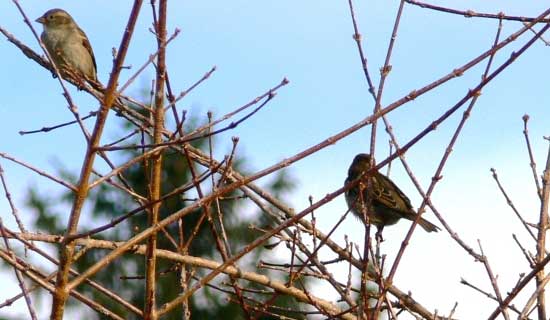
La Sparrow of Italy (I will pass) belongs to the order Passeriformes, family Passeridae, massive birds, with conical and robust beak, typical of granivores and usually not particularly bright color. There Sparrow of Italy it has a small size (14-16 cm) and has a clear sexual dimorphism. The adult male has brown back and wings flecked with black, white cheeks, hazel brown nape and head, black throat, gray breast. The female, on the other hand, as well as the young, is more faded, with a light brown back streaked with black, a beige nape and a gray chest and throat. The systematic placement of the species is the subject of controversy: not everyone considers the Sparrow of Italy a real species; some consider it a subspecies of the It will pass Oltremontana, others a stabilized hybrid of the latter with the Sardinian sparrow. In winter it often gathers in large flocks up to several hundred individuals.
PASSERA D'ITALIA: Habitat and diffusion
The reproductive and alimentary habits of the Sparrow of Italy they have had variations in historical times that have led the species to ever greater contact with anthropized environments, so much so that in the most economically developed areas it is rare to visit completely natural habitats. There Sparrow of Italy commonly known as "I will pass”Avoids denser vegetation, but also open agricultural areas (except in winter) and larger inhabited areas, with buildings that are too high, without protrusions or with no rows or parks. It shows no attraction to wetlands or coastal areas. For nesting the Sparrow of Italy it prefers artificial buildings but also natural rocky habitats, where it is often colonial. It breeds throughout Italy (except Sardinia), south-eastern France and Corsica, and throughout the rest of the Alps (Switzerland, Austria and Slovenia). The highest densities were found in the Po Valley, on the Campania coasts and in the inland areas of Puglia and Basilicata (Fornasari et al., 2001, unpublished report). In Italy it is mostly resident and partially migrant. It seems that the north-western populations of our country are moving towards the Mediterranean regions of France.
PASSERA D'ITALIA: Population size and trend
The breeding pairs in Italy, practically coinciding with the entire European contingent, have been estimated at 5-10 million (Meschini & Frugis, 1993). Opinions regarding the demographic trend of this species in recent years are conflicting.
PASSERA D'ITALIA: Conservation and management
La Sparrow of Italy it is considered not threatened and is not protected. The species does not seem to need particular protection measures, even if an estimate of the real demographic trends in progress would be desirable.
The woodcock, with its camouflage plumage, blends perfectly into the autumn undergrowth. This extraordinary adaptation guarantees protection from predators during migration. The woodcock (Scolopax rusticola), often called the "queen of the woods", is one of the birds...
__fg_link_0__ due to its smaller size, the body of a more squat shape, the hind limbs longer than the forelegs. The color of the coat ranges from sandy to dark gray-brown; the back is reddish, the abdomen and the lower part of the ...
FOX (Vulpes vulpes) Phenology S N R FOX: Description The Fox belongs to the order Carnivora, family Canidae. The Fox is a medium-sized mammal (moreover very variable through its enormous distribution range). On average, an adult individual has a height at the withers that ...
TAUPE (Streptotelia turtur) Phenology S N R Tortora: Description The Tortora belongs to the order Columbiformes, family Columbidae, the same that includes Wood pigeon and Pigeon. The Tortora differs from them for the small size (about 27 cm), for the slimmer and more elegant figure, and for ...
SASSELLO THRUSH (Turdus iliacus) Phenology S N R Sassello Thrush: Description. The Sassello Thrush belongs to the order Passeriformes, to the Turdidae family; the Redwing is the smallest of the common thrushes, measuring about 20 cm. It is very similar to the Song Thrush in the plumage of the upper parts, brown-gray, ...
BOTTACCIO THRUSH (Turdus philomelos) Phenology S N R BOTTACCIO THRUSH: Description The song Thrush belongs to the order Passeriformes, family Turdidae. It is a bird of medium to small size (about 22 cm), with a brown back and yellowish flanks and throat, paler on the belly. The lower parts of the ...
STARNA (Perdix perdix) Phenology S N R LA STARNA: Description The Starna belongs to the order Galliformes, family Phasianidae. The Gray Partridge is a medium sized Galliforme, measuring between 29 and 31 cm, slightly smaller than the Red Partridge. The Gray Partridge has a gray color ...
QUAIL (Coturnix coturnix) Phenology Y N R THE QUAIL: Description The Quail belongs to the order Galliformes, family Phasianidae. The Quail, the smallest European galliform, has a length of 16-18 cm and has a squat shape, both on the ground and in flight, so much so that it resembles a ...
RED PARTRIDGE (Alectoris rufa) Phenology S N R RED PARTRIDGE: Description The Red Partridge belongs to the order Galliformes, family Phasianidae. The Red Partridge is a galliform with a stocky and compact appearance, measuring about 33-35 cm, and is very similar to the Gray Partridge especially in the juvenile plumage. Adults of ...
Ptarmigan (Lagopus mutus) Phenology S N R Ptarmigan: DescriptionThe Rock Ptarmigan belongs to the order Galliformes, family Tetraonidae. Of medium size (35 cm), the Rock Ptarmigan is a species characterized by a showy sexual and seasonal dimorphism which manifests itself in different colors of the plumage.
Caccia Passione Srl
via Camillo Golgi nr. 1, post code 20090 Opera (MI) ITALY
CF and VAT number 08016350962
Newspaper registered at the Court of Milan nr. 17 of 20.01.2012 - ROC registration nr. 22180
Fully paid-up share capital € 10000
Contact us: redazione@cacciapassione.com
Not enough quota to unlock this post
Unlock left: 0
Are you sure you want to unsubscribe?
This site uses cookies to offer you a better browsing experience.


 PASSERA D'ITALIA: Description