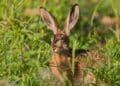
La Mini Hare belongs to the order Lagomorpha, family Leporidae. It has medium-small dimensions: body length between 40 and 45 cm, tail of 4-7 cm, foot of 8-10 cm and ear of 5-6 cm. The weight varies between 800 and 1500 g; generally, females are larger than males. There Mini Hare it is distinguished from the hare by its smaller size, shorter ears and more rounded appearance. More like the wild rabbit, the Mini Hare it differs from this for the decidedly longer ears and for the fact that, after the escape, it never takes refuge in the den. The hair color of the upper parts ranges from gray-brown to gray-reddish, while underneath it is white. The tail is soft and evidently white in the lower parts, so much so as to give it the common American name of cottontail ("cotton tail"). Unlike the Wild rabbit, it is a solitary species, only occasionally detectable in small groups.
MINI HARE: Habitat and distribution area
La Mini Hare it lives in a great variety of environments, from cultivated fields, to woods, to prairies, to uncultivated ones, provided they are characterized by the presence of bushes where to find shelter from any predators. There Mini Hare it has purely crepuscular and nocturnal habits. It feeds on a wide range of plant material: spontaneous and cultivated herbaceous plants, sprouts, parts of woody plants. The Cottontail, as Lepre e Wild rabbit, in times of deficiency, re-ingests part of its faeces to increase the intake of proteins, water and B vitamins, thus optimizing its metabolism. There Mini Hare gives birth from 3 to 7 times per reproductive season, between February and September, after a gestation of about 25-35 days, and they are able to give birth to up to 35 young per year. Males establish a strict hierarchy, on the basis of which they identify the mating priorities.The original area of diffusion extends from North America to the northern regions of South America. Introduced in France and Italy for hunting purposes, the Mini Hare it has expanded considerably around the original release nuclei, thanks to its high reproductive rate. In the territories beyond the Alps, however, it seems to have become extinct in recent times and currently in Europe it survives only in some fragmentary wild populations in northern Italy. Here it was in fact introduced for the first time in Piedmont in 1966; subsequently, in various areas of northern Italy, numerous other releases for hunting purposes took place (Prigioni et al., 2001).
MINI HARE: Population size and trend
In North America the Mini Hare it reaches a density of 9-10 individuals per hectare. In the north-eastern regions of the Italian peninsula there remains an isolated minimal population, located on a small lagoon island, under strict control of private individuals. In the western portions, the contingents of Mini Hare show a numerical increase and expansion along river banks and in road and rail embankments (Mitchell-Jones, 1999; Spagnesi & De Marinis, 2002). Observations indicate that the species is colonizing new territories in Lombardy (Vigorita et al., 2003a).
MINI HARE: Conservation and management
La Mini Hare belongs to an alien species, should be placed under strict control or eradicated (Vigorita et al., 2003a; Spagnesi & De Marinis, 2002). Its presence could in fact lead to competition events with similar species with which it shares the habitat (Common hare e Wild rabbit), although there are no known case studies on this interaction. In the points of greater density the Mini Hare it can also cause damage in the agricultural field, in particular to horticultural crops (Prigioni et al., 2001); in particular, it can affect crops of both, growing wheat and maize, young vines and poplar, fruit trees (Spagnesi & De Marinis, 2002). The total eradication of the species from the territory in a short time does not seem realistic, especially since, as a huntable species, it is continuously introduced. At present it would be appropriate to regulate the populations of Mini Hare existing to avoid any expansion into new territories, as well as prohibiting further releases into the wild and prohibiting detention in captivity (Spagnesi & De Marinis, 2002).
The woodcock, with its camouflage plumage, blends perfectly into the autumn undergrowth. This extraordinary adaptation guarantees protection from predators during migration. The woodcock (Scolopax rusticola), often called the "queen of the woods", is one of the birds...
__fg_link_0__ due to its smaller size, the body of a more squat shape, the hind limbs longer than the forelegs. The color of the coat ranges from sandy to dark gray-brown; the back is reddish, the abdomen and the lower part of the ...
FOX (Vulpes vulpes) Phenology S N R FOX: Description The Fox belongs to the order Carnivora, family Canidae. The Fox is a medium-sized mammal (moreover very variable through its enormous distribution range). On average, an adult individual has a height at the withers that ...
TAUPE (Streptotelia turtur) Phenology S N R Tortora: Description The Tortora belongs to the order Columbiformes, family Columbidae, the same that includes Wood pigeon and Pigeon. The Tortora differs from them for the small size (about 27 cm), for the slimmer and more elegant figure, and for ...
SASSELLO THRUSH (Turdus iliacus) Phenology S N R Sassello Thrush: Description. The Sassello Thrush belongs to the order Passeriformes, to the Turdidae family; the Redwing is the smallest of the common thrushes, measuring about 20 cm. It is very similar to the Song Thrush in the plumage of the upper parts, brown-gray, ...
BOTTACCIO THRUSH (Turdus philomelos) Phenology S N R BOTTACCIO THRUSH: Description The song Thrush belongs to the order Passeriformes, family Turdidae. It is a bird of medium to small size (about 22 cm), with a brown back and yellowish flanks and throat, paler on the belly. The lower parts of the ...
STARNA (Perdix perdix) Phenology S N R LA STARNA: Description The Starna belongs to the order Galliformes, family Phasianidae. The Gray Partridge is a medium sized Galliforme, measuring between 29 and 31 cm, slightly smaller than the Red Partridge. The Gray Partridge has a gray color ...
QUAIL (Coturnix coturnix) Phenology Y N R THE QUAIL: Description The Quail belongs to the order Galliformes, family Phasianidae. The Quail, the smallest European galliform, has a length of 16-18 cm and has a squat shape, both on the ground and in flight, so much so that it resembles a ...
RED PARTRIDGE (Alectoris rufa) Phenology S N R RED PARTRIDGE: Description The Red Partridge belongs to the order Galliformes, family Phasianidae. The Red Partridge is a galliform with a stocky and compact appearance, measuring about 33-35 cm, and is very similar to the Gray Partridge especially in the juvenile plumage. Adults of ...
Ptarmigan (Lagopus mutus) Phenology S N R Ptarmigan: DescriptionThe Rock Ptarmigan belongs to the order Galliformes, family Tetraonidae. Of medium size (35 cm), the Rock Ptarmigan is a species characterized by a showy sexual and seasonal dimorphism which manifests itself in different colors of the plumage.
Caccia Passione Srl
via Camillo Golgi nr. 1, post code 20090 Opera (MI) ITALY
CF and VAT number 08016350962
Newspaper registered at the Court of Milan nr. 17 of 20.01.2012 - ROC registration nr. 22180
Fully paid-up share capital € 10000
Contact us: redazione@cacciapassione.com
Not enough quota to unlock this post
Unlock left: 0
Are you sure you want to unsubscribe?
This site uses cookies to offer you a better browsing experience.