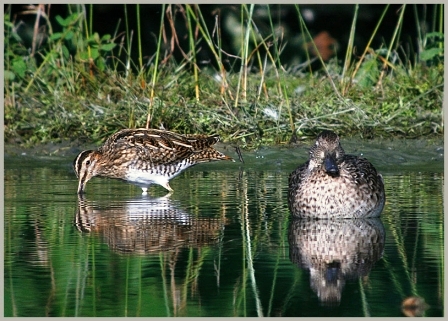
Il Shoveler belongs to the order Anseriformes, family Anatidae, aquatic birds known as ducks. The Shoveler it is part of the group of “surface ducks”, which only immerse their heads to feed themselves, without going under the water completely. It is a small duck (slightly larger than the Teal), with a body length of 37-41 cm and a wingspan of 60-63 cm. It is recognized in every age and dress for the olive-green color of the wing mirror. It has a clear sexual dimorphism. The male has a dark head, with a blackish vertex and a white crescent that goes from the eye to the nape; front part of the light gray-blue wing, particularly evident in flight. The female is brownish, similar to that of other species of surface ducks, however distinguishable from these thanks to the striped pattern on the head. The Shoveler it has a fast and regular flight, with sudden drops to the surface of the water and sudden ascents. In migration it forms flocks even of large dimensions, which fly compact and coordinated in cloud formation, with changes of direction and structure; in these flocks it often associates with some congenital species.
MESTOLONE: Habitat and distribution area
Il Shoveler it nests in freshwater ponds, even if not very large, sheltered and with sparse vegetation, usually avoiding environments too closed by arboreal vegetation. It also nests in flooded grasslands or wetlands. It is more numerous up to 300 m of altitude, exceptionally reaching 500 m. The Shoveler it essentially feeds on vegetables found on the surface of the water. Couples are formed in the winter quarters, before the spring migration, and therefore arrive already formed in the breeding sites. The spawning of the only annual brood (8-10 eggs) begins in April. Regular migrant, with migration peaks in September and March-April: the latter are much more numerous due to the type of arc migration involving the central Mediterranean. The populations of the western Palearctic are mainly trans-Saharan migrants: most of the winter observations are in fact considered accidental wintering (of these, certainly some refer to disabled individuals or those who escaped captivity). In Europe the Shoveler it nests continuously in the Balkan and eastern regions, with a more fragmented distribution in the western areas. The nesting area has undergone a tendency towards expansion towards the North, probably in correspondence with the increase in summer temperatures in the boreal zones. In Italy it is mainly migratory, breeder and only occasionally wintering.
Photo by Giancarlo Mariani - By Anatidi.it
MESTOLONE: Population size and trend
The estimate of breeding pairs in Europe varies between 650.000 and 1.100.000 (Heath et al., 2000), with a significant tendency to decline starting from the 70s. A decrease in the numbers is recorded, at least locally, also in Italy, where estimates indicate the overall presence of 350-500 breeding pairs (Brichetti & Fracasso, 2003). From the censuses of wintering Anatidae in Italy, the wintering in our country of a number of individuals of ladles between a few dozen and 630 (Chelini, 1984), located mainly in southern Italy.
MESTOLONE: Conservation and management
On a continental level the Shoveler it is considered a vulnerable species and in strong decline, probably due to the simultaneous loss of suitable habitats in the wintering and nesting areas (Hagemeijer & Blair, 1997). Also in Italy it is indicated in the Red List as a vulnerable species and the overall number of pairs seems to have recently decreased due to environmental changes (Perco, 1988). Due to the significant transit in March, the species has been intensely hunted, even in recent years, making up almost 70% of the Anatidae killed in this period. Hunting therefore undoubtedly affects the number of pairs able to stop and subsequently nest in the various regions. An early closure with respect to the spring migration would favor the occupation of suitable biotopes, and the growth of the number of breeding pairs, given this already ascertained by local observations (Di Carlo, 1976). The presence of the species in the winter season, as already explained, is mainly accidental and could perhaps be increased with the maintenance of suitable biotopes.
The woodcock, with its camouflage plumage, blends perfectly into the autumn undergrowth. This extraordinary adaptation guarantees protection from predators during migration. The woodcock (Scolopax rusticola), often called the "queen of the woods", is one of the birds...
__fg_link_0__ due to its smaller size, the body of a more squat shape, the hind limbs longer than the forelegs. The color of the coat ranges from sandy to dark gray-brown; the back is reddish, the abdomen and the lower part of the ...
FOX (Vulpes vulpes) Phenology S N R FOX: Description The Fox belongs to the order Carnivora, family Canidae. The Fox is a medium-sized mammal (moreover very variable through its enormous distribution range). On average, an adult individual has a height at the withers that ...
TAUPE (Streptotelia turtur) Phenology S N R Tortora: Description The Tortora belongs to the order Columbiformes, family Columbidae, the same that includes Wood pigeon and Pigeon. The Tortora differs from them for the small size (about 27 cm), for the slimmer and more elegant figure, and for ...
SASSELLO THRUSH (Turdus iliacus) Phenology S N R Sassello Thrush: Description. The Sassello Thrush belongs to the order Passeriformes, to the Turdidae family; the Redwing is the smallest of the common thrushes, measuring about 20 cm. It is very similar to the Song Thrush in the plumage of the upper parts, brown-gray, ...
BOTTACCIO THRUSH (Turdus philomelos) Phenology S N R BOTTACCIO THRUSH: Description The song Thrush belongs to the order Passeriformes, family Turdidae. It is a bird of medium to small size (about 22 cm), with a brown back and yellowish flanks and throat, paler on the belly. The lower parts of the ...
STARNA (Perdix perdix) Phenology S N R LA STARNA: Description The Starna belongs to the order Galliformes, family Phasianidae. The Gray Partridge is a medium sized Galliforme, measuring between 29 and 31 cm, slightly smaller than the Red Partridge. The Gray Partridge has a gray color ...
QUAIL (Coturnix coturnix) Phenology Y N R THE QUAIL: Description The Quail belongs to the order Galliformes, family Phasianidae. The Quail, the smallest European galliform, has a length of 16-18 cm and has a squat shape, both on the ground and in flight, so much so that it resembles a ...
RED PARTRIDGE (Alectoris rufa) Phenology S N R RED PARTRIDGE: Description The Red Partridge belongs to the order Galliformes, family Phasianidae. The Red Partridge is a galliform with a stocky and compact appearance, measuring about 33-35 cm, and is very similar to the Gray Partridge especially in the juvenile plumage. Adults of ...
Ptarmigan (Lagopus mutus) Phenology S N R Ptarmigan: DescriptionThe Rock Ptarmigan belongs to the order Galliformes, family Tetraonidae. Of medium size (35 cm), the Rock Ptarmigan is a species characterized by a showy sexual and seasonal dimorphism which manifests itself in different colors of the plumage.
Caccia Passione Srl
via Camillo Golgi nr. 1, post code 20090 Opera (MI) ITALY
CF and VAT number 08016350962
Newspaper registered at the Court of Milan nr. 17 of 20.01.2012 - ROC registration nr. 22180
Fully paid-up share capital € 10000
Contact us: redazione@cacciapassione.com
Not enough quota to unlock this post
Unlock left: 0
Are you sure you want to unsubscribe?
This site uses cookies to offer you a better browsing experience.


 MESTOLONE: Description