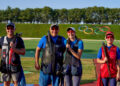
An interesting and well-attended conference recently took place at the Provincial Council Hall, bringing together representatives of local hunting areas, professional agricultural organizations, and hunting associations to discuss the topic of "Wildlife and Hunting Management in the Province of Asti." Organized by the Agriculture, Hunting, and Fishing Department of the Province of Asti, the event was opened by the newly appointed Regional Councilor for Agriculture, Hunting, and Fishing, Giorgio Ferrero from Asti, and by Paolo Guercio, the provincial director responsible. The conference was coordinated and the closing remarks delivered by Pier Paolo Mussa. "The challenges associated with the increase in wild boar and roe deer populations and the steady decline in sedentary game populations require a change of approach," explained Roberto Mazzoni della Stella and Francesco Santilli, two wildlife experts with decades of experience managing wildlife in Tuscany. "Environmental interventions are needed. The current system of restocking and capture is sixty years old. And it shows."
The two experts' presentations were decidedly interesting. They taught us that recent American studies have shown that the use of hydrolyzed casein can have a decidedly positive effect in combating damage caused by roe deer and deer. Meanwhile, products with a more evocative than practical effect, such as wolf urine, seem truly useless. However, some unscrupulous retailers still sell them. "We have tried," explained Paolo Guercio, "to focus on experiences in other areas, to introduce elements of innovation in wildlife management and create the conditions for a wildlife balance compatible with agricultural and human activities."
Laura Cavallero, a technician from the Province of Asti, provided a detailed presentation of the wild boar containment plan in the Asti area. However, despite the significant investment of resources and manpower, the containment plan, by the Province's own admission, does not appear to have yielded the desired results. This is despite the fact that the number of captures is higher than expected. Animals and nature always struggle to adapt to plans, whether three- or five-year. Meanwhile, the sums paid to farmers are decreasing. They went from €170,000 two years ago to just over €150,000 last year.
Perhaps this is also a symptom of the increasingly strong spending review or of the fact that farmers in some areas have now definitively given up farming. A few smiles, in the age of the internet has finally aroused in the audience the obligation to communicate by fax of all capture interventions but you know the bureaucracy must take its course and therefore a "Register of wildlife operators" is on the horizon with a lot of qualification and training course. Register that should be the novelty of the next plan. Two interesting degree theses closed the proceedings. Doctors Laura Comparato and Martina Tessarin, experts in environmental biology, have in fact talked about partridge and red partridge in the provincial context.
(17 July 2014)
Source: LaNUovaProvincia
You May Also Like ..